top of page


1,800 ATHLETES · 270 TEAMS · 20 YEARS · 95% SUCCESS RATE · 5.0 ON GOOGLE · 20 UNIVERSITIES · US NATIONAL FIELD HOCKEY TEAM ·

You have already seen the player they can be.
It is there at practice.
The confident decisions, quick reactions, skill, the freedom to play without over thinking.
Then the competition starts.
The stakes get higher and everyone is watching.
And suddenly, they are not playing the game you know they can play.
They are thinking about the last mistake. Worrying about the next one.
Playing not to get it wrong instead of trusting what they already know.
They have trained their body, they have trained their skills. But the mental side of performance is missing in action.
That’s the part we train.
When the mistake comes in the first 10 minutes and the rest of the competition spirals out of control.
We rehearse the moments practice rarely prepares you for.

When you cannot sleep the night before the biggest game of the season.
When the coach makes the sub and your brain turns it into the worst thing ever.
When your hands are shaking and sweaty while everybody is watching.
When you mess up and the next 5 minutes decides who wins.
We do not just talk about these moments, we rehearse them.
Breathing → Self-talk → Visualization → Reset routines.
Practical mental skills built around the athlete, their sport, and their season.
When your leader has to stand up to a friend who is not being a good teammate.
I was a head case.
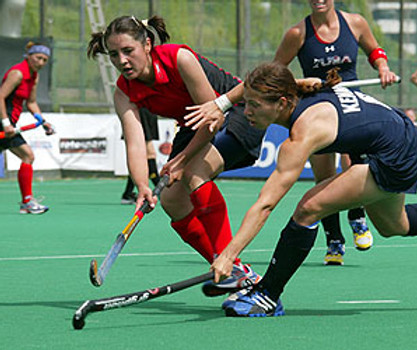
4 years on the US National Field Hockey Team.
A silver medalist at the Pan American Games.
And a plan that was supposed to work:
Work harder than everybody else.
It got me recruited. It got me to the national team.
Then it stopped working.
Because everybody there worked just as hard. And most of them were better. (X-Olympians)
I'm sitting there not starting, and I have no idea what to do about it.
Then someone at the Olympic Training Center asked me one question.
She handed me a sheet of paper. I still have it. And pretty soon I'm reading the game faster than I ever had, and I hadn't changed a single thing about how I trained.
So years later I'm coaching, and I hear a kid on the sideline say the exact thing I used to say to myself, and oh my gosh.
That's the whole reason I do this. 1,800 athletes and 270 teams since then, across 20 universities, and about 95% of them get the result they came for.
I've been that athlete. I know what it feels like, and I know what your athlete can do about it.

FOR PARENTS
You know the player who shows up in practice.
So what happens between practice and game day?
Do they play differently when the stakes are higher?
Do they come off the field already replaying what went wrong?
Do you find yourself coaching them through it on the drive home?
You have tried talking about it.
Then you tried leaving it alone.
And now you are not sure what to say anymore.

You can say the right thing and still not be the one
they’ll listen to.
Sometimes an athlete needs someone outside the family to help them work through the mental side of performance.
So they can learn to handle it themselves and you can get back to being their parent who unconditionally loves them.
FOR COACHES AND CLUB DIRECTORS
The team should know how to hold it together when the competition turns.
How long does it take your team to start playing?
5 minutes? 10?
Does it take a goal against you to wake them up?
And when that goal goes in, who does the resetting?
Is it them? Or is it you?
The whole team learns practical routines for resetting, refocusing, and responding under pressure.
Your staff learns them too, so the work belongs to your program instead of depending on me.
I have run the coach training at Alexandria Soccer every year since 2018. Their coaches run it now.
.jpg)

IF YOU ARE AN ATHLETE READING THIS
You know what it feels like
when your game changes.
Maybe you’re confident in practice but overthink everything when it counts. Maybe one mistake stays in your head longer than it should.
I know those moments too. I’ve been that athlete.
We’ll build practical mental skills for your sport, your position, and the moments that get in your head.

Client Successes


Cameron Foster ·
Gymnast
Just knowing that I could get through something so dark and overcome it in that way, it was a very pivotal moment in my career.


Tim Lenzo ·
Alexandria Soccer Association
We got blown out 5-0. I reminded the boys the difference the mental preparation is making, and seeing it in the last two scrimmages really helped them buy into it


Jordan ·
5th Grade Gymnast
I'm glad I met with you today to have better tools to be less nervous before my competition. Thank you!


Field hockey athlete ·
12 weeks in
I no longer feel myself being like, what if I am not good enough? I am just in love with the fact that I get to play and I get to have fun.
THE CONFIDENCE CHECK
Is it real confidence, or the kind that disappears after one bad play?
Real confidence holds. The other kind comes from a good result, somebody telling them they are good, or finally getting the starting spot.
And that feels great. Until the next time somebody else starts instead of you.
Take 3 minutes to find out which kind you are looking at, and what to work on next.
If you are the athlete taking this yourself, your answers are yours.

Choose the support that fits.
Mental training that fits into any sport.
Mental reps recorded in my voice, so athletes can practice without me being in the room.
A pregame routine that fits into a real warm-up, a reset for after the mistake.
Support between sessions when a bad week happens, and communication with parents after sessions, so you are not left wondering what to say at home.
10 to 15 minutes a day. That is the practice.

THE CHAMPIONSHIP
The Championship Newsletter
The mental game between practices.
Every week, Robyn shares a real story from the work and a mental skill you can use.
Athletes, parents, and coaches are all welcome
Tell me what keeps happening out there.
If they keep hesitating when the pressure hits.
Your team takes 10 minutes to settle.
One mistake turns into another and messes up the whole game.
You are not sure whether mental training is what you need.
Tell me what you are seeing.
I will tell you what I would do about it, and whether I am the right person to help.
If I am not, I will tell you that too.

*I am not a medical professional and I do not treat anything diagnosable. What I teach is mental performance skills, for athletics.
bottom of page